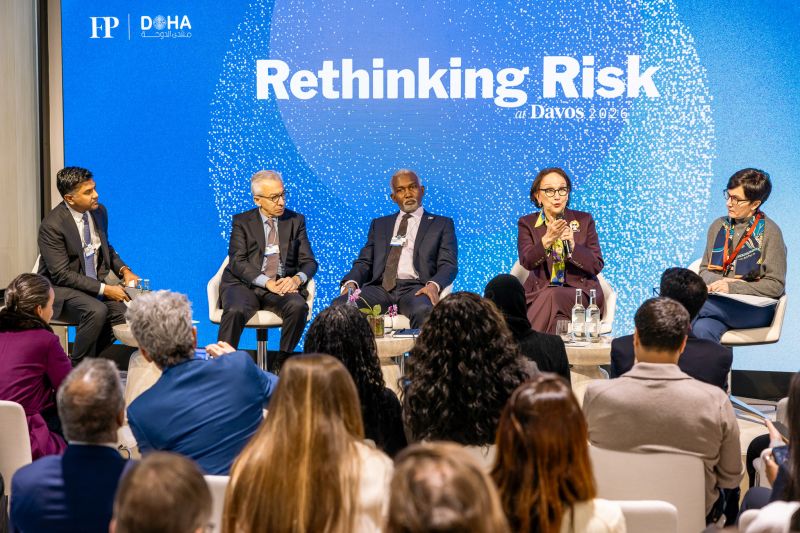
The World Economic Forum Annual Meeting 2026 provided a high-level platform for UN Trade and Development (UNCTAD) to reinforce its mission at a time of rising global uncertainty. INSME member UNCTAD, under the leadership of Secretary-General Rebeca Grynspan, engaged in an intense and far-reaching programme of bilateral and multilateral exchanges, placing trade, development and risk reduction firmly at the centre of global discussions.
Throughout Davos WEF 2026, Secretary-General Grynspan met with ministers and senior representatives from across regions and institutions, reflecting UNCTAD’s role as a bridge between developed and developing economies, and between global policy and real-world constraints. Across the discussions, a consistent message emerged: multilateralism must be rooted in inclusive participation, not uniformity. As Secretary-General Grynspan emphasized, global cooperation does not require consensus on everything to enable action. What matters is the ability to solve problems together, reduce systemic risks, and keep agreements viable even when differences persist.
A central theme was risk and inequality. In today’s global economy, the same shock can have vastly different consequences depending on a country’s financial capacity. While some economies can borrow at interest rates as low as 1%, others face rates exceeding 12%. This imbalance means that risk is not shared evenly—and when crises hit, the poorest countries bear the heaviest costs. UNCTAD warned that the world is facing growing and overlapping shocks, from economic volatility to climate impacts, while becoming less capable of managing risk collectively. Fragmentation, Secretary-General Grynspan noted, is not only inefficient; it makes the global economy more fragile for everyone.
Source: UNCTAD