
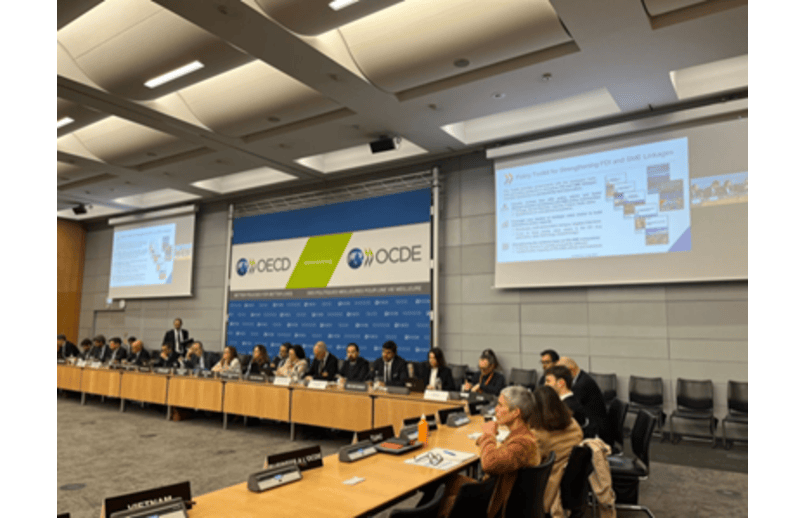
On November 6, the OECD Committee on SMEs and Entrepreneurship (CSMEE) and the Investment Committee (IC) held a joint session on the role of Foreign Direct Investment (FDI) in enhancing SMEs’ productivity, innovation, and resilience in the context of evolving global value chains and sustainability requirements.
Giovanni Zazzerini, INSME’s Secretary General, highlighting barriers constraining SMEs’ inward and outward FDI. SMEs have a limited absorptive capacity from Multinational Enterprises (MNEs), meaning their ability to absorb and use external knowledge, which hampers their opportunities to inward FDI. This is mostly due to their lack of skilled human resources and because of financial and legal constraints. Looking at outward FDI, SMEs have the potential to make their FDI more sustainable and less likely to shift locations, as they are deeply integrated into their local ecosystems and rely on long-term partnerships with local suppliers and community networks. However, such a potential is often underestimated by intermediary institutions, which instead favor MNEs.
How can policymakers better support SMEs? Zazzerini suggests that policymakers should support SMEs’ development of internal capabilities and acceleration of digital adoption, their participation in international trade, as well as favor their cluster and network creation.
Overall, the session reaffirmed the critical role that SMEs play in global value chains and the broader economy. By strengthening SMEs’ access to FDI, supporting their digital transformation, and creating inclusive trade policies, governments can empower SMEs to thrive. This will help build a more resilient, innovative, and sustainable global economy, ensuring that SMEs can navigate the challenges of an increasingly uncertain world.
Source: INSME Secretariat, OECD