
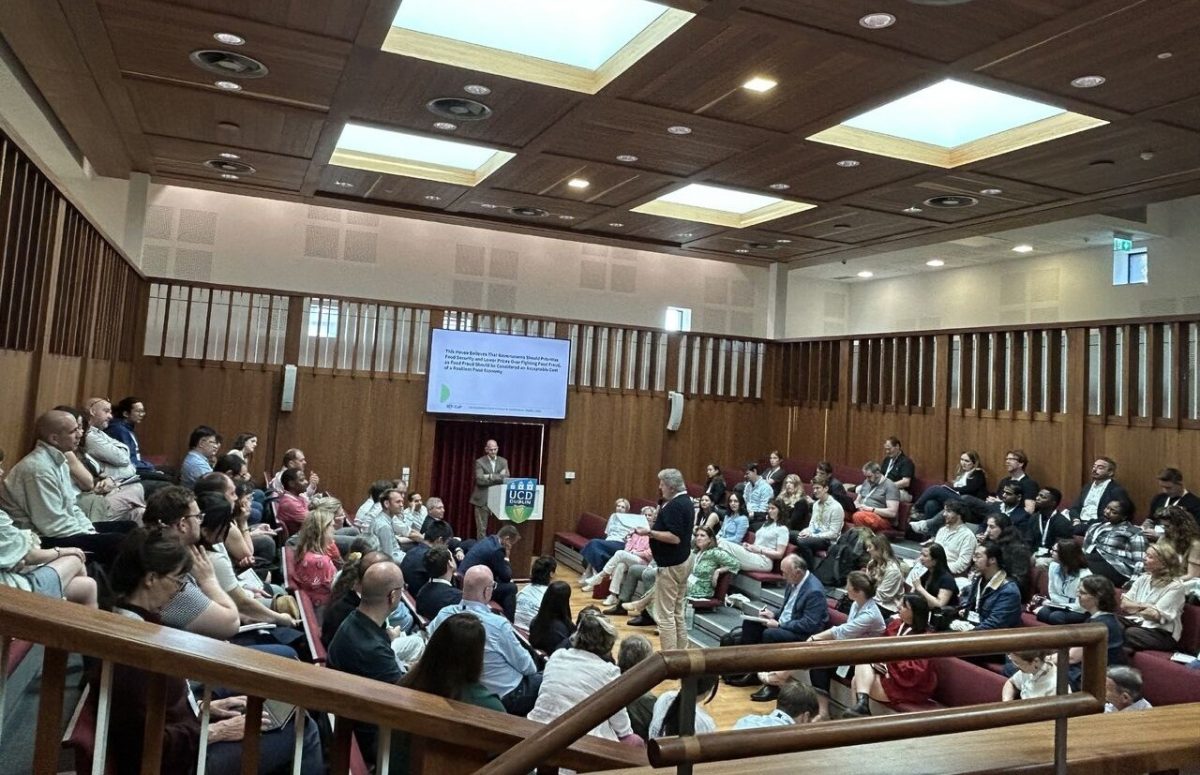
Food fraud is one of the most threatening dangers to SMEs competitiveness. The European Food Fraud Community of Practice (EFF-CoP), of which INSME is a funding member, was built specifically to tackle this problem. INSME Secretary General Giovanni Zazzerini participated in the EFF-CoP meeting in Dublin from the 27th to the 28th of May to discuss the economic consequences and the market disruptions resulting from this fraudulent behaviour in the European economy.
Zazzerini participated in an interactive panel discussion displaying the possible advantages and disadvantages of loosening market regulations on food fraud to protect consumers from high prices, especially in case of shortage and widespread crises. The INSME Secretary General pointed out the economic consequences in the long term of these decisions: food fraud may lower prices in the short term, but it weakens the food industry by undermining trust. When buyers cannot distinguish genuine products from fraudulent ones, they become less willing to pay a premium for quality. As a result, authentic producers receive prices that no longer reflect their higher standards, while fraudsters benefit from lower costs. Over time, this discourages investment in quality, pushes genuine producers out of the market, and lowers overall product quality across the sector. SMEs are especially vulnerable because they compete through trust, authenticity, quality, and local sourcing rather than scale or price. If fraud becomes widespread or tolerated, consumer trust erodes and these firms lose the very differentiation on which their competitive advantage depends.
This is a particularly relevant issue for the European market and economy. Despite running a highly regulated food market, the European Union (EU) continues to grapple with widespread food fraud, incurring annual losses amounting to billions of euros.
The European Food Fraud Community of Practice is an innovative initiative started in 2025 aimed at transforming the battle against food fraud and increasing transparency throughout food supply chains. By uniting a wide range of stakeholders, from researchers to regulators, to industry leaders and representatives from the organic sector, EFF-CoP fosters a vibrant, sustainable ecosystem for research and innovation.
Source: