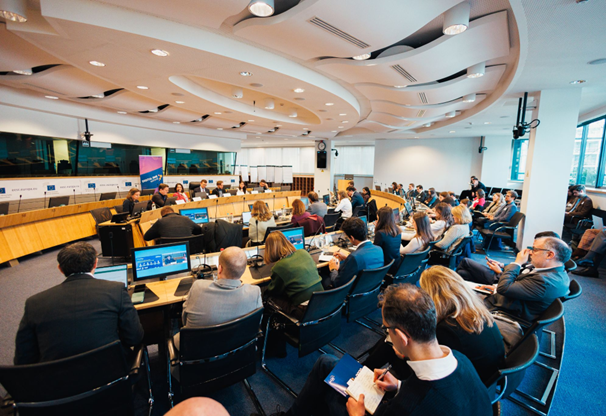
The European Digital SME Alliance held its annual event on December 4 in Brussels, at the premises of the European Economic and Social Committee. The event, attended by the INSME Secretariat, featured a series of high-level debates and business-oriented sessions.
The third edition of the summit brought together tech innovators and leading voices in the business sector to advance the vision of a sovereign and competitive Europe. In his keynote speech, Sebastiano Toffaletti, Secretary General of the European Digital SME Alliance, highlighted the pivotal role of European tech SMEs in the EU digital economy.
The event opened with a lively discussion on the impact of EU regulations and digital transition ambitions on European tech SMEs. The first panel, which included Laura Balke, Head of Sector at DG CNECT of the European Commission, revisited the long-standing debate on the balance between regulation and competitiveness, addressing the broader question of how the EU can achieve technological sovereignty. Speakers unanimously agreed that initiatives such as the Digital Omnibus and the forthcoming 28th regime must deliver tangible benefits for European innovators. What Europe’s homegrown tech actors are calling for is a simpler, more harmonised regulatory framework that enables companies to scale and fully contribute to the future of the European digital economy.
Throughout the event, all the speakers addressed the important question of how to define the actions and policies needed to build a European technological stack, and they all highlighted the importance for industry, civil society, and policymakers to strengthen their partnerships. One clear takeaway is that Europe’s competitiveness depends on its ability to achieve sovereignty over core technologies by doubling down on SME-driven, innovative, homegrown solutions. This would also require Europe to strengthen existing and create new public–private partnerships to accelerate adoption and scaling, and to make the regulatory landscape more coherent and innovation-friendly.
For this purpose, during the summit two initiatives were launched: the Tech Sovereignty Catalogue and two certification labels “Software-made-in-Europe” and “Software-hosted-in-Europe”, to make tech solutions visible, verifiable, and accessible, allowing both public administrations and businesses to identify European alternatives across the tech stack.
Source: Digital SME Alliance